The Good Old Days – or Why We Need to Be Humanly Intelligent
And so, the TV series Babylon Berlin has come to an end. As I watched the final episodes and saw the desperate struggle to save the republic, democracy, and the society of the 1920s unfold on screen, I found myself thinking once again that the world of that time is not all that far removed from our own.
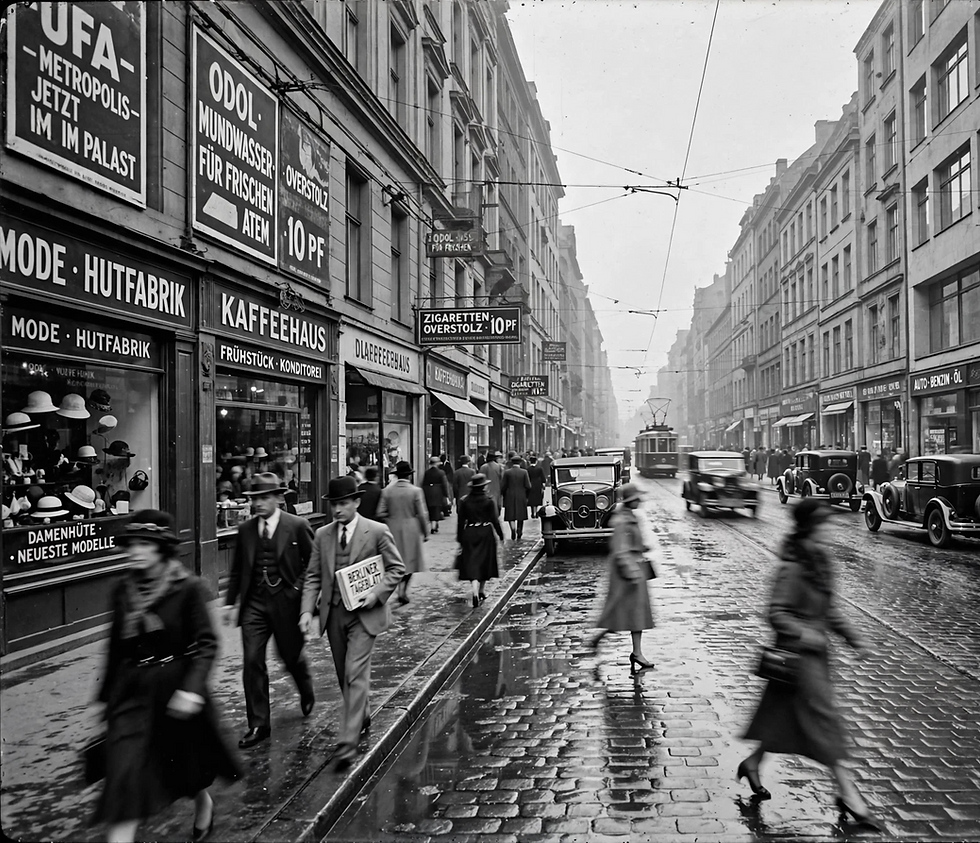
Germany was modern in the 1920s. Women had reached the right to vote in 1918. With the introduction of women’s suffrage, Germany became one of the more progressive democracies of its time. The Weimar Constitution formally guaranteed women the same civic rights and duties as men. Fashion, lifestyles, and social conventions were changing. Art and culture were experimental, and architects and designers were looking to the future.
Today, too, we like to think of ourselves as modern, enlightened, and progressive. But progress is not a one-way street. The 1920s were not merely a time of new beginnings. They were also a time of extreme contrasts, economic hardship, political violence, and growing radicalisation. Modernity and tradition existed side by side. Society, the republic, and democracy had to withstand pressure from all sides, from every direction. Until, eventually, it all became too much.
Looking back, much of what happened seems almost inevitable. But the people living at the time did not know how history – their future!- would unfold.
What We Call Progress
Today, progress seems to be measured above all by how much easier, faster, and more convenient something has become. Almost everything can be done with a few clicks. Information is available at any time, news reaches us in real time, and there is an app, a guide, or a simple solution for almost every problem. That is progress. That is wonderful. But is everything that has become easier necessarily better?
As an author with a particular affinity for words, I notice this especially when it comes to language. Of course, a hundred years ago, not everyone who spoke eloquently and had good manners was necessarily a good person. Still, I find myself wondering why we are so quick to dismiss or change things that may actually be worth preserving.
Language changes. That is neither surprising nor cause for concern. It is allowed to evolve. But I increasingly get the impression that we are not merely expressing ourselves more clearly; we are expressing ourselves in increasingly simplistic ways. Sentences become shorter, thoughts are reduced to sound bites, and ideas are simplified to the point where no one has to give them a second thought. Everything must be immediately digestible, preferably while scrolling past.
Yet communicating clearly is an art. It makes complex ideas accessible without distorting them. Sophisticated language does not have to be incomprehensible. It can challenge us, open up new perspectives, and expand our vocabulary.
Sometimes I feel that we expect less and less of people. As though looking up an unfamiliar word, reading a longer text, or sitting with an idea that cannot be summed up in a single sentence were somehow too much to ask.
But this is nothing new. At school, I took advanced German literature. I once asked if we could read Goethe’s Faust. Even back then, the response was that not everyone would understand it, so we had better leave it out. I found that astonishing then, and I still do: an advanced German course culminating in the Abitur, the highest German school-leaving qualification (basically the allowance to study at the University), without reading one of the greatest works in the German literary canon? What exactly do we think students are capable of – and what do we not trust them to do?
So perhaps the problem is not that language has become too sophisticated. Perhaps many people have simply lost the patience to engage with it.
This is particularly obvious to me when it comes to AI-generated texts. Why do so many headlines have to follow the same formula: “What We Know – and What We Don’t”? Does everything really have to be explained? Am I no longer allowed to work things out for myself? Am I no longer allowed to think for myself?
Many people simply outsource their thinking. And then everyone wonders why the results are so interchangeable.
What Progress Should Look Like Today
Directness is not the same as honesty. Consideration is not a weakness. A free society must be able to tolerate disagreement, provocation, and uncomfortable truths. But there is a difference between expressing a clear opinion and openly showing contempt for other people. We can disagree without belittling one another. We can criticise without being insulting. And we can speak plainly without treating every form of courtesy as unnecessary baggage.
And why, exactly, are we always expected to put up with everything?
Putting up with something takes effort, sometimes even a conscious act of overcoming resistance. In my view, a democratic society should not have to feel like a constant struggle. It should not continually require us to steel ourselves. It should not leave us feeling that we must stand our ground against absolutely everything and everyone.
And yes, disagreement has become an integral part of democratic culture. But there is a reason we speak of a culture of debate.
We can dismantle outdated hierarchies and still preserve decency. We can become more modern without making life unnecessarily difficult for one another. That, to me, would be progress fit for our time. And progress should mean more than simply learning to put up with things.
Especially because we know how things turned out. The future of those who lived in the 1920s is our past, our history. Could we not be wiser? Or at least better at avoiding the same mistakes over and over again?
We need neither romanticise the past nor condemn it wholesale. We can recognise that earlier generations created things from which we still benefit today, while acknowledging the injustices of their time. And yet, not every old custom is automatically obsolete, not every new development is worth celebrating, and above all, not every simplification is an improvement.
A Utopian Idea?
What would the present look like if language were not reduced to the bare minimum necessary? If people could be polite without being considered antiquated, conservative, or even backward? If we did not always have to put up with everything? A present in which we were not artificially intelligent, but humanly intelligent?
Perhaps we should spend less energy either romanticising the past or congratulating ourselves on being superior to it. Instead, we should take a closer look. The real question is not whether everything used to be better. The real question is whether we are truly making everything better today.
PS: And then there is one very personal thought that stayed with me after watching the final episode of Babylon Berlin. As a historian, I actually found myself sitting there, wishing the series would end differently. Wishing that, for just one moment, history would refuse to follow the course we know it took. Pretty human, no?


