War Attracts More Attention Than Peace
It is a strange phenomenon: When a war begins somewhere in the world, attention turns there almost instantly. News reports on front lines, arms deliveries and political decisions. Images of destroyed cities and fleeing people go around the world. It is analyzed, commented on, discussed. It is loud. The reporters are loud because they have to make themselves heard over the noise. War is loud because its sound is the roaring of engines, the alarms. People are loud because they try to draw even more attention to themselves and their situation.
Peace, on the other hand, is quiet. Diplomats do not shout.
When I gave a seminar on the Middle East at the University of Hamburg years ago and, in the first session, asked my students which seminar topics they wanted to choose for their presentations, they all wanted to work on topics surrounding the numerous conflicts and wars. Nobody was interested in theories of peace and conflict solutions. I practically had to impose the topic on the students. Even back then I said: Why is nobody here interested in peace? Too boring? Too few dead? — Only with the greatest difficulty could I persuade a few students to engage with Matthies and Czempiel after all. It still stays with me to this day!
I keep stumbling across it again and again.
Here, for example: In the network “Humanities and Social Studies Online,” there are forums on all kinds of subject areas. Peace and war are listed directly one below the other, but the number of current participants is downright dramatically and strikingly unbalanced, as can be seen in the current screenshot.
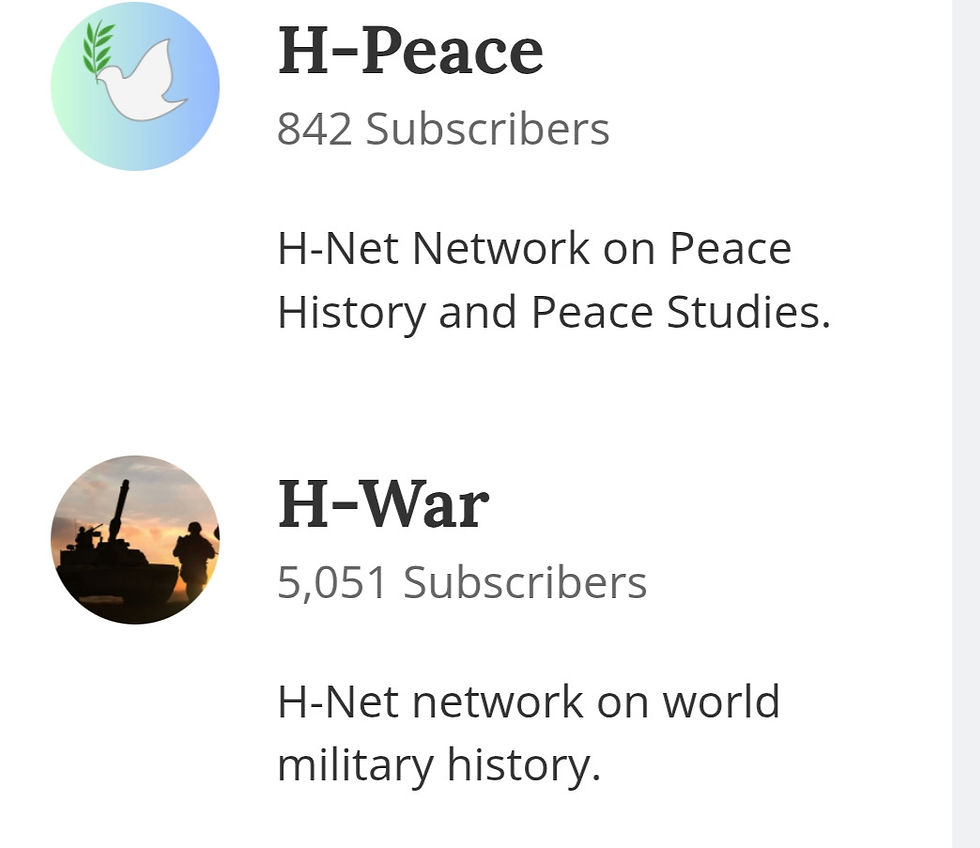
War is loud, visible and dramatic. Peace, on the other hand, seems to be quiet. Too quiet. It consists of conversations, negotiations, compromises and sometimes simply of something not happening. No shot is fired. No city is destroyed. Nobody has to flee. A war provides clear images and dramatic stories. There are fronts, enemies, victims, victories and defeats. There are turning points and heroes, guilty parties and those responsible. Peace, on the other hand, rarely has a spectacular beginning and even more rarely a clear ending. It often develops in small steps and can break apart again at any time. Is that what makes the difference? And yet, one of the most famous images in history is an image of peace.

Is it the fascination with violence? Why should anyone be fascinated by that? The extraordinary in situations in which everything is at stake and the familiar order collapses?
But in a world in which there seem to be only conflicts, violence and war left, isn't peace precisely the extraordinary?
Why does peace receive so little attention? I recently published a text in which I wrote about the German Nobel Peace Prize laureate, Foreign Minister and Chancellor of the Weimar Republic, Dr. Gustav Stresemann (p. 27). The response was great — but not because anyone knew that it was the 100th anniversary of the Nobel Prize award, no, but because hardly anyone had ever heard of him. Colleagues themselves could not believe that they did not know the name!
Why are there any stories about the people who prevent a conflict? About negotiations that avert a war? About former enemies who eventually sit together at the same table? About the many small decisions through which violence simply does not happen?
Peace needs a story in order to become visible. This story is often a quiet one.
A war is relatively easy to tell. It begins on a specific day, has battles, turning points, names, images and victims. There is something to report as long as the fighting continues. And when the war is over, its course can be recorded in maps and chronologies. In a world in which language consists only of superlatives, in which everything is “unbelievable” and which seems no longer able to do without sensational presentation, peace is almost impossible to tell.
The history of peace is usually a story of transitions, rapprochement and possibilities. It is more complicated to tell because it does not consist of a single event. Peace is rarely the big moment. Much more often, it is a long chain of small moments.
History is often told as a sequence of events. And events are frequently most visible where something breaks: a war begins, a government falls, a border is crossed, an assassination takes place. The years before that, in which people negotiated with one another, found compromises and defused conflicts, often appear merely as PRE-history.
A central aim of Stresemann's policy was to normalize relations between Germany and its former wartime opponents, above all the so-called hereditary enemy France. Germany was to be reintegrated into the international community of states. That does not sound particularly exciting. No tanks. No battle. No dramatic escape. No heroic scene in which someone raises a flag under fire.
Instead: negotiations, treaties, diplomatic talks, rapprochement.
And yet, something very great was at stake. Former wartime enemies were to become political partners again. What a peculiarity of peace: When it works, it is hardly seen. A person who prevents a war does not leave behind destroyed cities. A diplomat who defuses a conflict does not produce a battlefield. A politician who achieves a compromise can often not even prove what would have happened without that compromise.
Today, one might perhaps call this a communicative weakness. Stories about peace are not “unbelievable,” sensational, and a superlative per se. And without these linguistic elements, many people today can hardly be reached anymore. That is a problem. Because peace is not loud; it is deafeningly quiet! But it is anything but ordinary.


